
Web Deploys vs React Native: Mobile Is Stuck in 2010
Web developers deploy dozens of times a day. Mobile developers wait days. Discover how the two worlds drifted apart and how OTA updates are closing the gap.
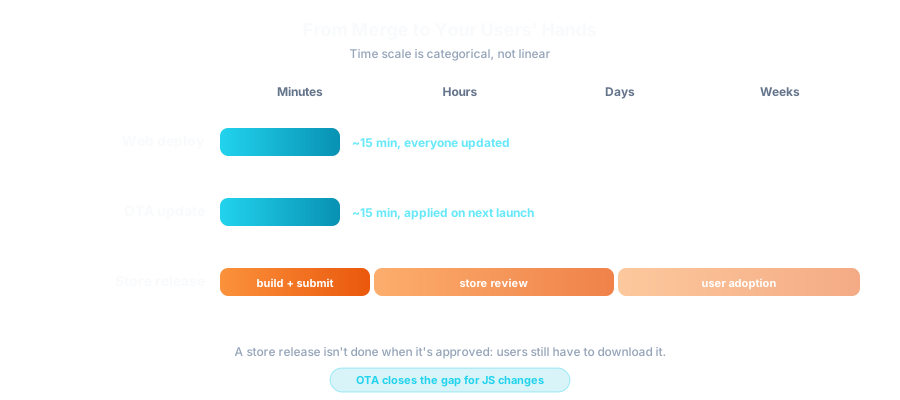
Shipping a one-line fix to a mobile app still takes days. The same fix on web takes minutes: a developer merges a pull request and it's live before their coffee gets cold.
On mobile, the same merge means building a binary, bumping a version, submitting for review, waiting, releasing, and hoping users actually update. Same bug. Same fix. Two completely different decades.
Here's why that gap happened, what it actually costs teams, and how to close it.
How the Web Got Fast
It's easy to forget that web deploys used to be scary too. In the 2000s, "deploying" often meant FTPing files to a server on a Friday and praying. Releases were events: scheduled, announced, and staffed late into the night.
Then, in the span of a few years, everything changed:
- Continuous integration became table stakes. Every commit built and tested automatically.
- Continuous deployment stopped being radical. Companies like Flickr and Etsy made "deploy dozens of times a day" a normal engineering practice, not a stunt.
- Rollbacks became a button. If a deploy went bad, you reverted in minutes. Bad deploys went from disasters to non-events.
- Feature flags decoupled deploy from release. Code could ship dark and turn on gradually.
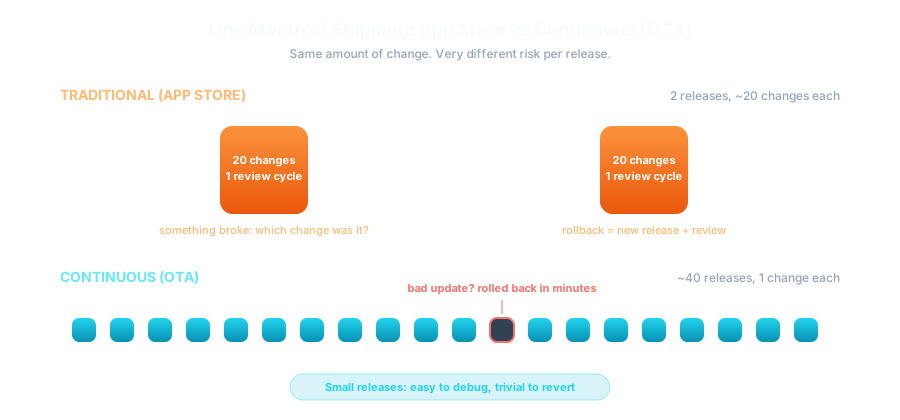
What speed actually bought them wasn't just velocity. It was a different relationship with risk: when shipping is cheap and reversible, you ship small changes often, each one easy to reason about. When shipping is expensive, you batch changes into big risky releases.
Hold on to those two words, cheap and reversible. Mobile got neither.
Meanwhile, on Mobile
The same fix, side by side
Put the two workflows next to each other and the gap is hard to unsee:
| Web in 2026 | Mobile in 2026 | |
|---|---|---|
| Time from merge to users | Minutes | Days to weeks |
| Who approves the release | Your team | An external reviewer |
| Rollback | One click, instant | A whole new release, plus review |
| Users on the latest version | Everyone, on next page load | Whoever chose to update |
| Deploy frequency | Daily or more | Weekly to monthly release trains |
| A bad Friday deploy | Revert and go home | A very bad weekend |
That right column isn't describing 2026. It's describing how the web worked in 2010, with an extra gatekeeper on top.
And to be fair to Apple and Google: the review queue isn't even the slow part anymore. Reviews usually clear in about a day. The real gap between "merge" and "users" is adoption, waiting for people to actually install the new version. That part can take weeks, and there's no expedited request for it.
Why Mobile Got Stuck
None of this is because mobile engineers are behind the times. The constraints are structural.
Distribution is owned by gatekeepers
On the web you own the server, so you own the release. On mobile, Apple and Google sit between you and your users.
Their review process exists for real reasons: malware, scams, platform quality. But it means every release, even a typo fix, pays the same toll.
The artifact is a binary on someone else's device
A website lives in one place, and you update that place.
An app is copied onto millions of devices you don't control, running versions you can't retire. Weeks after a release, a meaningful share of your users are still on the old version, bug included.
Rollback barely exists
Neither store lets you truly roll back. Your best option is submitting yet another release, through the same review queue, while the broken version keeps hurting users.
The one mechanism that made web deploys safe is the one mobile never got.
So teams adapted around the constraint
Sound familiar? Every one of these is a rational response to expensive shipping:
Release trains
Ship every two weeks, because shipping daily is impossible.
Code freezes
Stop the world so the release can be stabilized.
One-shot QA cycles
Test everything up front, because there's no cheap fix later.
Hotfix war rooms
Escalation paths, expedited review requests, crossed fingers.
All reasonable. All symptoms of the same disease: shipping is expensive, so everything gets built around shipping rarely.
What Getting Stuck Actually Costs
The cost isn't just slow hotfixes, though those are painful enough. It's what expensive releases do to how teams work.
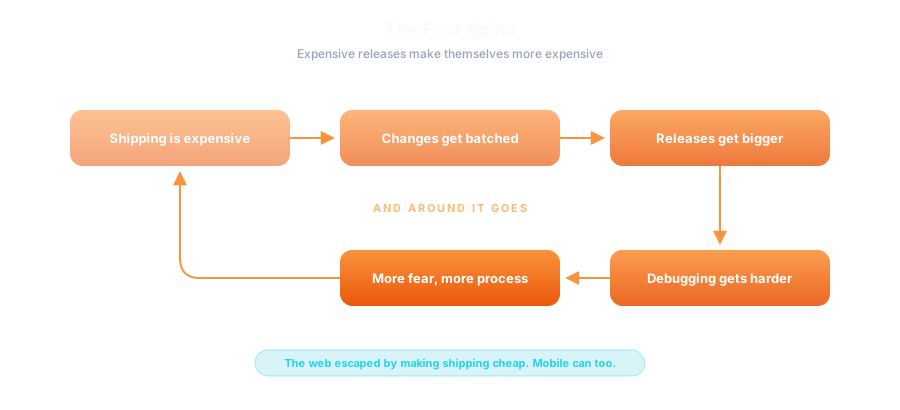
Once the spiral is spinning, it touches everything:
- Experiments become luxuries. Every iteration costs a review cycle, so teams stop trying small things. Small things cost as much to ship as big ones.
- Crash windows are measured in days. On the web, the clock to resolution runs in minutes. On mobile: expedited review if you're lucky, and then adoption lag on top. Roughly half of your users are still on the old version a week after the fix ships, crash included.
- Roadmaps get defensive. When a mistake takes a week to undo, "let's not risk it" wins more arguments than it should.
Adoption lag isn't something you can out-engineer with better update prompts. Even Apple, with near-total control of the iOS update experience, needed around 150 days to get iOS 26 onto 74% of recent devices. Your app has far less leverage than the operating system does.
And while you wait on a fix, your app's rating takes the hit. Ratings don't roll back either.
The Escape Hatch: Shipping Like the Web Again
Here's the thing that changed the math: for React Native and Expo apps, most of what you ship day to day isn't native code. It's JavaScript. Your components, your logic, your styles, your fixes.
And JavaScript doesn't need an app store to travel.
Is this allowed? Yes. Both Apple's guidelines and Google's policies permit updating JavaScript served by frameworks like React Native, as long as updates don't change the app's core purpose. This is the same mechanism Expo Updates and the now-discontinued CodePush built on.
How OTA updates close the gap
That's what Over-The-Air updates are: your app checks a server for a new JS bundle, downloads it in the background, and swaps it in.
- No new binary to build and sign
- No review queue for JavaScript changes
- No waiting on users to visit the store: the update applies on next launch
Native code changes still go through the normal release process (and should). But the everyday changes, the ones that used to wait for the train, ship like a web deploy.
The table, revisited
| Store release | OTA update | |
|---|---|---|
| Time from merge to users | Days to weeks | Minutes |
| Review | Required | Not required for JS changes |
| Rollback | New release, new review | Instant, one command |
| Users on the latest version | Whoever updates | Everyone, on next launch |
The web needed cheap, reversible deploys to escape 2010. OTA gives mobile exactly those two properties.
Where Turbopush Fits
Here's what that same one-line fix looks like with Turbopush: you merge the PR, CI builds the JS bundle, and Turbopush serves it to your app. On their next launch, users download the update in the background and get the fix. No binary, no review, no waiting. You watch adoption climb in real time from the dashboard.
If something goes wrong, you hit rollback and every user reverts to the previous version on their next launch. One click, no review queue.
Turbopush is an Over-The-Air update platform built for React Native, supporting both bare React Native and Expo. There are no storage or bandwidth charges on any plan, so the cost of shipping often stays flat. (We did a full pricing breakdown against Expo Updates if you want the numbers.)
Want to see the loop in action? Try the live demo, it takes about two minutes.
Conclusion
The web didn't get fast because web developers were smarter. It got fast because deploys became cheap and reversible, and everything else followed: smaller changes, less fear, faster iteration.
Mobile has been stuck on the other side of that line, not for technical reasons but for distribution ones. OTA updates move the everyday work of shipping back under your control, where it belongs.
Your users don't care how the fix arrived. They care that it arrived today instead of next week.
Get started with Turbopush and ship your next fix in minutes.
How is this guide?